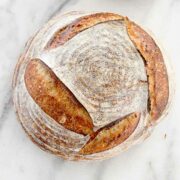
Easy Sourdough Bread
This easy sourdough bread recipe is simple to make and has a crisp crust and soft middle, making it anything but basic! Made with only 5 ingredients, this bread is the perfect beginner sourdough.
Servings: 12 slices
Ingredients
Levain Build:
- ½ cup all purpose flour
- 3 oz water
- ½ tablespoon yesterday’s starter Recipe Here
Final Dough:
- 2 ¾ cups all purpose flour
- ½ cup rye flour
- 8 oz water
- ⅓ oz kosher salt
- 5 ½ oz liquid levain above
Additional Ingredients:
- rice flour for dusting the proof basket if using
Instructions
Mix the Liquid Levain:
- The 12 to 14 hours before you want to mix your dough, build the levain. In a clean container, mix the flour, water, and starter. Stir with a small spatula until the water has hydrated the flour. With this small quantity, I find it easier to double the amount of the levain build. You have enough to make your dough and feed the levain. Here is a whole tutorial on building a liquid levain.
Make the Final Dough:
- Combine all ingredients for the final dough in the bowl of a stand mixer fitted with a paddle attachment and mix until the flour is fully incorporated.
- Once the flour has been completely incorporated, let the dough sit for 15 minutes (autolyze) to develop gluten.
- Switch to the dough hook and increase the mixer speed to medium to develop the gluten. This dough will not form a ball around the hook because it is too wet of a dough.
Proofing and folds:
- Scoop the dough into an oiled bowl and cover with plastic wrap. Place in a warm spot for 30 minutes. I like to use the proof setting on my oven.
- First set of folds: Fold each of the four sides into the center, pulling the dough up and allowing it to smack down on top of the remaining dough in the bowl. Repeat on all four sides until you have a nice packet. This is developing more gluten! Cover and proof for an additional 15 minutes.
- Final set of folds: Repeat the process as with the first set of folds. By this point, the dough should hold together very well and stay in a ball in the center after you’ve completed your folds. If your dough immediately relaxes, rest for another 15 minutes and perform another set of folds.
- Bulk Proof: Cover the dough and return it to the warm spot to proof. Check the dough every 45 minutes. This will take about 2.5 hours. You want to oil or flour your hand and feel the dough. It should feel light and airy and not stiff or dense.
Shaping:
- Pre-shape: Dust the top of the dough in the bowl with flour. Turn the dough out onto a lightly floured surface. Fold each of the four sides towards you into the center, turning the dough after each fold. This will create a little packet. Flip the dough so the seam is on the counter. Shape it into a round by using both hands to pull the dough towards you. Once you have a round ball with a smooth top, allow it to sit and bench rest for 15 minutes.
- Final Shape: Repeat the same process as with the pre-shape until you have a tight round ball. Place the dough on a piece of parchment or flip it upside down into a proof basket that has been dusted with rice flour. Cover with plastic wrap.
- To bake the next day: Place the covered basket into the refrigerator to retard the dough overnight. This will slow the proofing of the yeast, allowing you to bake 12-18 hours later. To bake the same day: Place the basket back into the warm spot and allow to rise another 2.5 to 3 hours or until it feels light and airy and has doubled in volume in the basket. The volume will be tough to tell if you are proofing it on parchment because it doesn’t contain or control the shape of the sourdough. Proceed to the baking step below.
Baking:
- Preheat the oven to 450°F convection or 470°F non-convection with the Dutch oven or baking pan inside. Meanwhile, cut a piece of parchment a little larger than the loaf.
- When your oven is ready, toss a little flour onto the dough, then turn the dough out of the basket onto the parchment. [If you proofed your dough on parchment, skip this step] Score the dough using a lame, razor blade or paring knife. You want to score midway between the bottom and the top. With this bread in a round shape, I prefer to make it square so that it rises straight up and maintains its original round shape.
- Take the preheated Dutch oven from the oven, gently lower the dough into the pot and cover it with the lid. Place in the oven and bake for 20 minutes.
- Remove the lid and continue baking for 25 minutes or until the loaf is a dark amber brown and the internal temperature reads 210°F.
- Remove the loaf from the Dutch oven, carefully remove the parchment, and then cool completely. This allows the crumb to set.
Video
Notes
Yield – 1 loaf
Presentation -- Score the bread with a sharp knife, razor blade, or lame using quick, even pressure for a deep main cut and any additional decorative ones.
Flavor -- This simple bread highlights flour and starter, and avoiding overheating the dough preserves flour flavonoids, which is why the autolyze rest is essential.
Technique -- This recipe uses a liquid levain, meaning a starter fed at a higher water ratio without needing a separate maintained starter.
Storage -- Store the loaf cut-side down at room temperature for a crisp crust, or slice, wrap, and freeze individual pieces for later use.
Nutrition
Calories: 139kcal | Carbohydrates: 29g | Protein: 4g | Fat: 0.4g | Saturated Fat: 0.1g | Polyunsaturated Fat: 0.2g | Monounsaturated Fat: 0.04g | Sodium: 307mg | Potassium: 52mg | Fiber: 1g | Sugar: 0.1g | Calcium: 7mg | Iron: 2mg