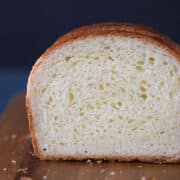
Brioche Bread
A brioche bread recipe that is not only soft, buttery, and simple to make, but brings a traditional French bakery straight to your kitchen! So tender that it melts in your mouth, while being perfect for dinner, sandwiches, and later some easy bread pudding!
Servings: 24 Slices
Ingredients
- 4 cups all purpose flour
- ½ cup water
- ¼ cup milk
- 2 ½ teaspoons kosher salt
- 1 tablespoon dry active yeast
- 2 eggs
- ¼ cup sugar
- ⅔ cup unsalted butter cold but pliable
Makes: 9 x 5inch rectangle
Instructions
Mix the dough:
- In the bowl of a stand mixer whisk together the dry active yeast and warm water. Allow to sit for 10-15 minutes or until bubbly.
- Add the milk, sugar, eggs, salt, and flour to the stand mixer bowl. Fit with the paddle attachment and mix on low speed to incorporate.
- Once the ingredients are mixed and the flour has been hydrated, switch to the dough hook attachment and mix on medium speed until a smooth dough forms. It will not stick to the sides of the bowl. Use the window pane test to tell if the dough is ready to add the butter.
- Add the softened (not melted) butter to the stand mixer and mix on low until the butter disappears into the dough.
- Remove the dough from the stand mixer using a stiff silicone spatula or a bowl scraper, and place it in a lightly oiled bowl. Cover with plastic wrap and then place in a warm spot. Allow to proof 30 minutes. Give the dough one set of folds.
Bulk Proof:
- Cover the dough and place back into the warm spot to proof. Check the dough every 45 minutes. This will take about 1 ½ hours. You want to oil or flour your hand and feel the dough. It should feel light and airy and not stiff or dense.
Pre-shape & Bench rest:
- Turn the dough out onto a lightly floured surface. Divide the dough in half. Fold each of the four sides towards you into the center, turning the dough after each fold. This will create a little packet. Flip the dough so the seam is on the counter. Shape it into a round by using both hands to pull the dough towards you. Once you have a round ball with a smooth top, cover to keep the top from drying out and allow it to sit and bench rest for 15 minutes.
Final Shape:
- Final Shape: We are going to shape these into a log (or bâtard in French bread terminology). Take one of the dough rounds and flip it over. Grab the top and bottom edges and gently pull it into a small rectangle. Place it on the counter and fold the top edge down 2/3rd of the way and press it into the dough. Rotate so that the unfolded edge is now away from you and fold that edge down towards you to meet the bottom edge. Press to seal. Now we are going to do 2 thumb folds. Take the top edge with your right hand and fold it over your thumb about half way down, pressing to seal as you go. Repeat until you have folded the entire length. You will notice the dough getting tighter and also longer.
- Repeat the thumb fold once more, sealing really well on the bottom. You should now have a log shape that is even in width along the whole length, that is the length of your pan, and tight enough to not slouch onto the counter. If the dough is too loose, repeat the thumb fold once more.
- Spray with non-stick spray or butter a 9×5 inch loaf pan. Place the log into the sprayed pan seam-side down. Cover with plastic wrap and place once more in your warm spot.
- Allow to proof until the dough just starts to reach the top of the pan. When that happens, preheat your oven to 350°F. Brush the top of the dough with a well beaten egg for a golden brown finish, being careful not to let it drip down the sides. As soon as it is preheated, bake for 35-40 minutes or until the internal temperature reads 185°F using an instant read thermometer.
- Allow to cool 5 minutes in the pan then remove to a wire rack to cool completely.
Video
Notes
Makes: 2, 9 x 5 inch rectangles
Variations – Flavor the dough with citrus zest, spices or herbs. Try incorporating add-ins like chopped nuts, dried fruits or candied zest after dough development.
Storage – Store well-wrapped or in an air-tight container at room temperature for up to 5 days or freeze immediately after cooling for up to 2 months. The refrigerator will dry out the bread faster.
To Freeze – Pre-slice, wrap VERY well in plastic wrap, place in a gallon zip-top baggy and freeze. Remove as many slices as desired and toast (or microwave).
Nutrition
Calories: 140kcal | Carbohydrates: 18g | Protein: 3g | Fat: 6g | Saturated Fat: 4g | Polyunsaturated Fat: 0.4g | Monounsaturated Fat: 2g | Trans Fat: 0.2g | Cholesterol: 30mg | Sodium: 211mg | Potassium: 37mg | Fiber: 1g | Sugar: 3g | Vitamin A: 190IU | Vitamin C: 0.001mg | Calcium: 11mg | Iron: 1mg