
This post may contain affiliate links. Please read our disclosure policy.
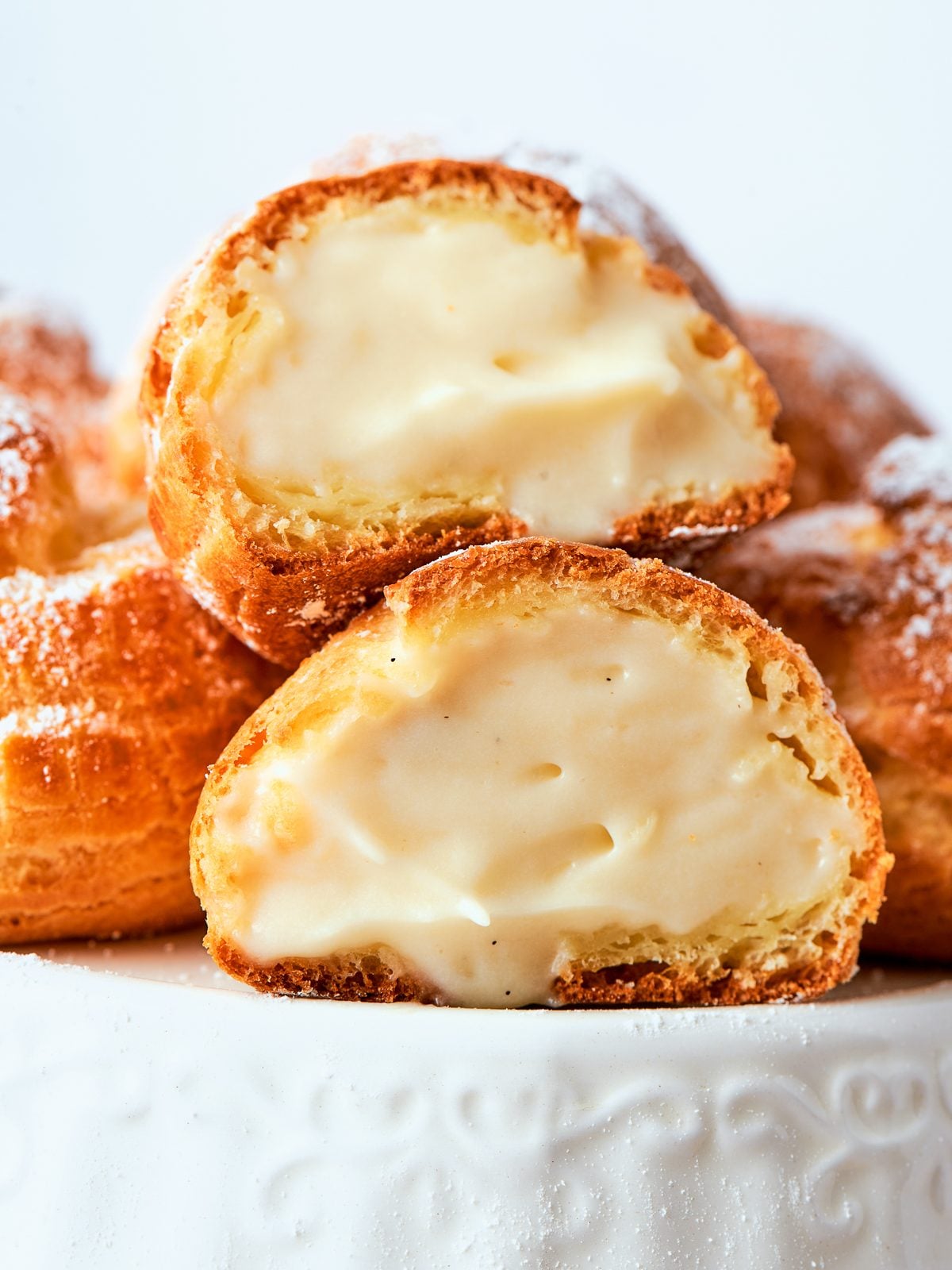
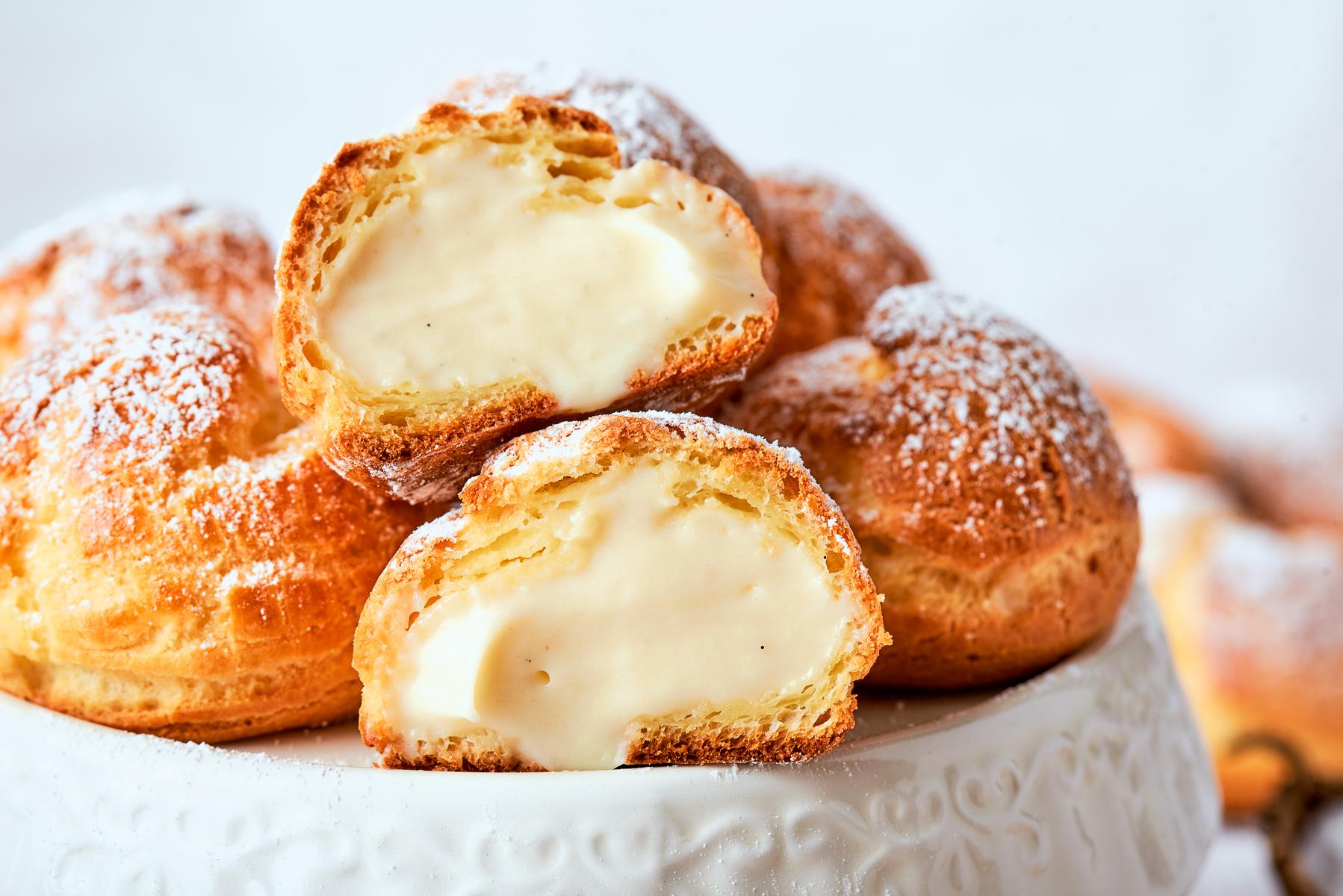
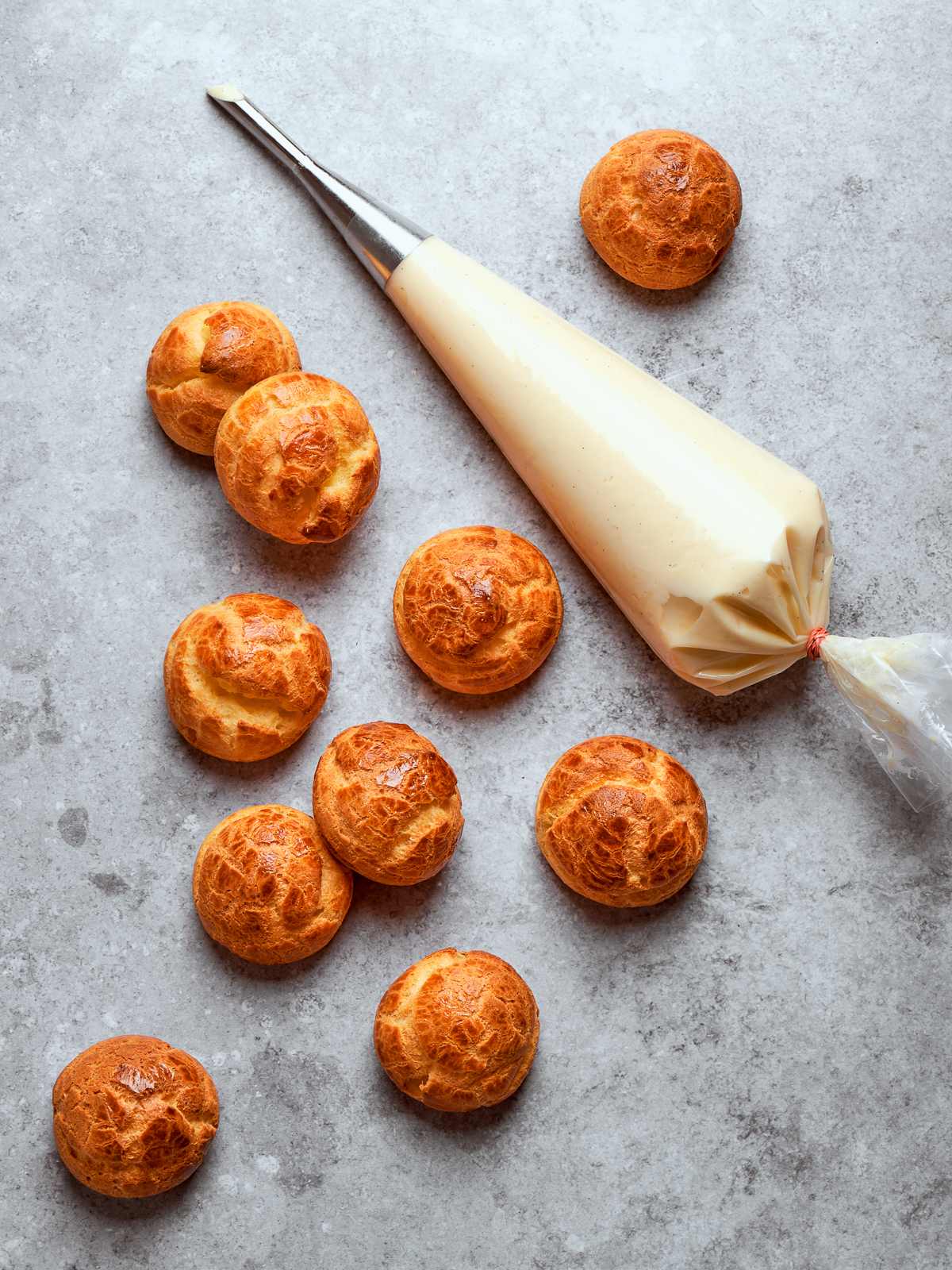
Crème légère is classic French pastry cream lightened with freshly whipped cream. The result is a silky, airy filling with true vanilla flavor that works beautifully in tarts, mille-feuille, and as a filling for choux pastry like cream puffs.
A Quick Look At The Recipe
This is a brief summary of the recipe. Jump to the recipe to get the full details.
Jump to RecipePrep Time
20 minutes
Cook Time
10 minutes
Cooling Time
1 hour
Total Time
1 hour 30 minutes
Servings
75 large cream puffs
Difficulty
Intermediate — requires making pastry cream from scratch and folding in whipped cream without deflating it.
Calories *
23 kcal per serving
Technique
Stovetop custard method for the pastry cream base; whipped cream folded in after the base is fully chilled.
Flavor Profile
Vanilla, lightly sweet, rich, and creamy.
* Based on nutrition panel
I used this crème légère to fill a fresh strawberry tart and it held its shape beautifully for hours. The tip about chilling the pastry cream completely before folding in the whipped cream made such a difference — no deflating at all. The vanilla flavor comes through so clearly. This is my new go-to filling. ⭐⭐⭐⭐⭐
Lauren
Why This Recipe Works
- Classic French ratio, precisely calibrated. The balance of pastry cream to whipped cream is not arbitrary. The right ratio gives you a filling that is light enough to feel airy but stable enough to hold its shape inside choux, mille-feuille, or a layered trifle.
- Properly tempered eggs prevent scrambling. Adding hot milk gradually to the yolk mixture brings the eggs up to temperature without cooking them. The result is a smooth, lump-free pastry cream base every time.
- Whipped cream folded at the right consistency. Soft peaks are the target before folding, not stiff peaks. Soft peaks incorporate easier, will not overwhip and separate during additional folding and piping, and gives the finished crème légère its characteristic texture.
- Versatile across multiple applications. Crème légère works as a filling for cream puffs, éclairs, and mille-feuille, and it layers beautifully in a trifle like this coconut trifle. One recipe, many uses.
Table of Contents
Crème légère is a staple of the French pastry kitchen, and learning to make it well opens up a wide range of classic desserts that all start from the same base.
It pairs naturally with buttery classic puff pastry and pâte à choux, and it works just as well spooned into something casual like a trifle. Try it in place of the lightened lemon curd in my berry trifle.
If you want to see the pastry cream base in a different context, my Banana Cream Pie uses the same foundation with a slightly richer finish.
Ingredients & Substitutions

- Whole Milk: Whole milk is important for richness and proper mouthfeel; lower fat milk will taste thinner and set softer.
- Vanilla Bean: The vanilla bean infuses the milk with deep, complex flavor that holds up against the richness of the eggs and cream. Steeping it in the hot milk extracts both flavor and aroma, and scraping the seeds ensures the classic speckled look you see in quality pastry cream. If you want to see vanilla bean at the center of a simpler dessert, my Homemade Vanilla Pudding uses it the same way.
- Granulated Sugar, divided: The sugar sweetens the custard and helps protect the egg proteins from curdling when heated. Dividing it between the milk and the egg mixture ensures everything dissolves smoothly and combines without lumps.
- Egg and Egg Yolks: The whole egg provides structure and body, while the yolks are the primary thickening and enriching agents, delivering the fat and emulsifiers that make pastry cream smooth and luxurious. Together they give the custard enough body to hold its shape while staying silky enough to fold with whipped cream.
- Cornstarch: Cornstarch is the starch thickener that stabilizes the pastry cream so it sets firmly and does not weep when folded with whipped cream. It must be fully dissolved in the egg mixture before heating, then brought to a boil to activate its thickening power fully.
- Heavy Whipping Cream: Whipped separately and folded into the cooled pastry cream, the cream is what transforms this into crème légère, making it lighter and airier than pastry cream alone. Use cream with at least 36% fat so it whips to medium peaks and holds structure in the finished filling. If you enjoy working with whipped cream in mousse-style applications, my White Chocolate Mousse is a good next step.
- Powdered Sugar: Powdered sugar sweetens and lightly stabilizes the whipped cream through the small amount of cornstarch it contains. Its fine texture dissolves quickly so the cream stays smooth without any grittiness.
- Vanilla Extract: The extract reinforces vanilla flavor once the mixture is cold, when aromas are more muted than they were during cooking. Adding it to the whipped cream or cooled pastry cream lets you fine-tune the intensity without risking flavor loss from heat.
See the recipe card for full information on ingredients and quantities.
Variations on This Crème Légère
- Matcha Cream. Whisk matcha powder into the milk before heating to infuse the pastry cream base with earthy, slightly bitter flavor, the way I made it on Beat Bobby Flay.
- Chocolate Version. Add finely chopped dark or milk chocolate directly to the hot pastry cream after it comes off the heat, stirring until fully melted and smooth before chilling. You could also add chocolate to my caramel pastry cream recipe for an even more elevated filling!
- Adjusted Cream Ratio. Increase the proportion of whipped cream for a lighter, more mousse-like filling, or reduce it for a denser texture that holds firmer in sliced applications like mille-feuille.
Professional Tips
- Chill the pastry cream completely before folding. Adding whipped cream to warm pastry cream is the single most common reason crème légère turns out dense and flat. The pastry cream must be fully cold, no warmer than refrigerator temperature, before you fold.
- Boil the pastry cream for a full minute. Pulling it off the heat too early leaves the cornstarch underactivated, and the cream will weep and thin out once folded. You will see the mixture go from glossy and loose to thick and smooth at the boil: that visual shift is your cue.
- Refresh the pastry cream before combining Even simply beating the pastry cream in a bowl with the back of a stiff spoon or spatula loosens the cornstarch bonds just enough to allow easy incorporation of the whipped cream. This will maximize volume and increase stability. .
- Sacrifice some whipped cream for a better crème légère. Sacrifice is a baker’s term that means you take a small portion of a light filling (like whipped cream) and vigorously combine it with a stiffer filling (like pastry cream) to loosen the stiffer filling. This allows for easier incorporation of the remaining whipped cream resulting in a light and smooth crème légère.
How to Make Crème Légère
Use these instructions to make crème légère, a classic French pastry cream lightened with freshly whipped cream.
Tip: Spreading the pastry cream thin on a sheet pan rather than leaving it in a deep bowl cuts the cooling time significantly, which I always do when I need it ready the same day.
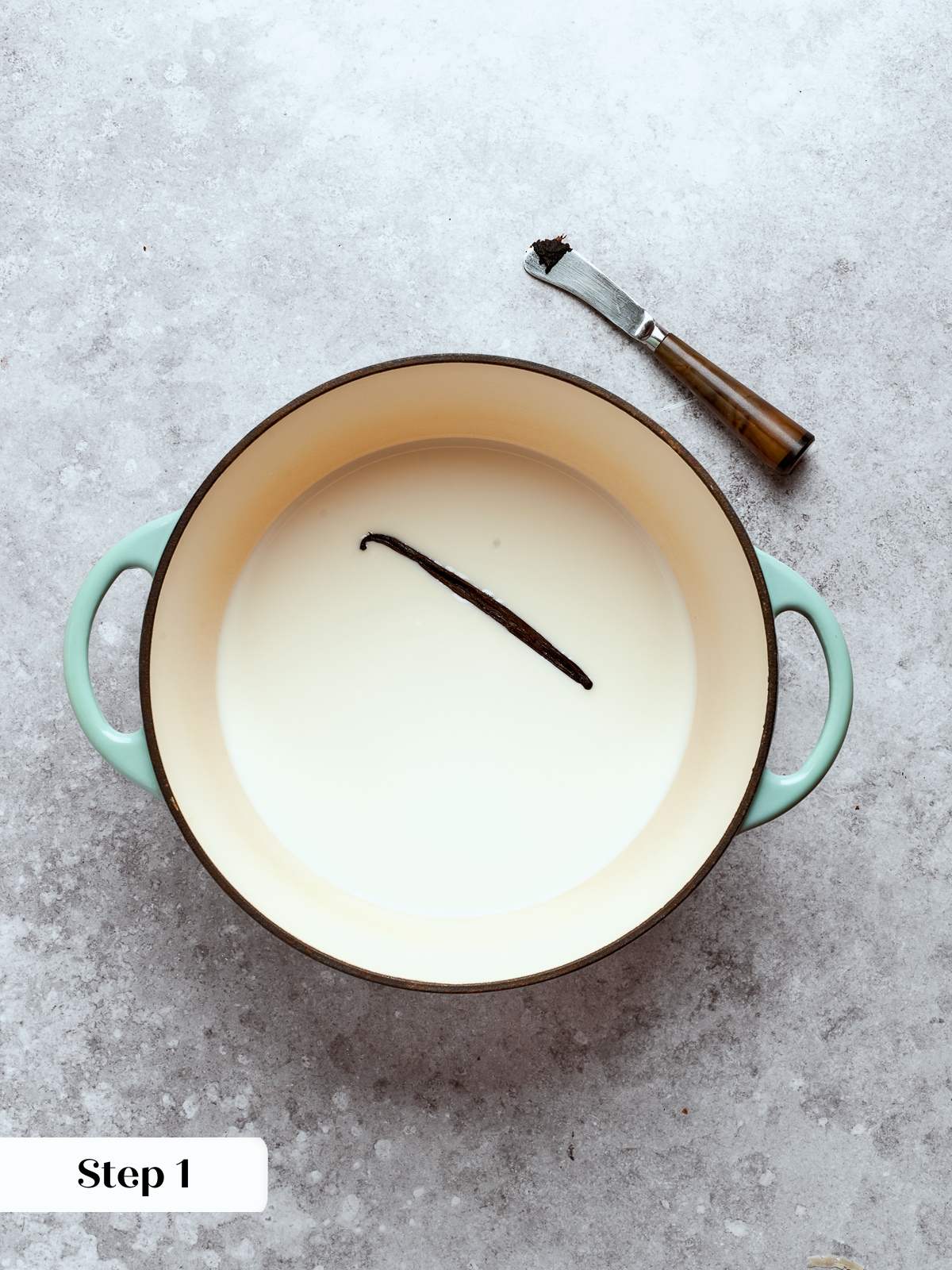
Step 1: Infuse and heat the milk. In a large, high-sided saucepot, combine the milk, vanilla bean pod and seeds, and about half the sugar (photo 1). Stir to combine and bring to a rolling boil over medium-high heat, stirring occasionally until the sugar fully dissolves. The milk will foam up as it approaches a boil, which is completely normal.
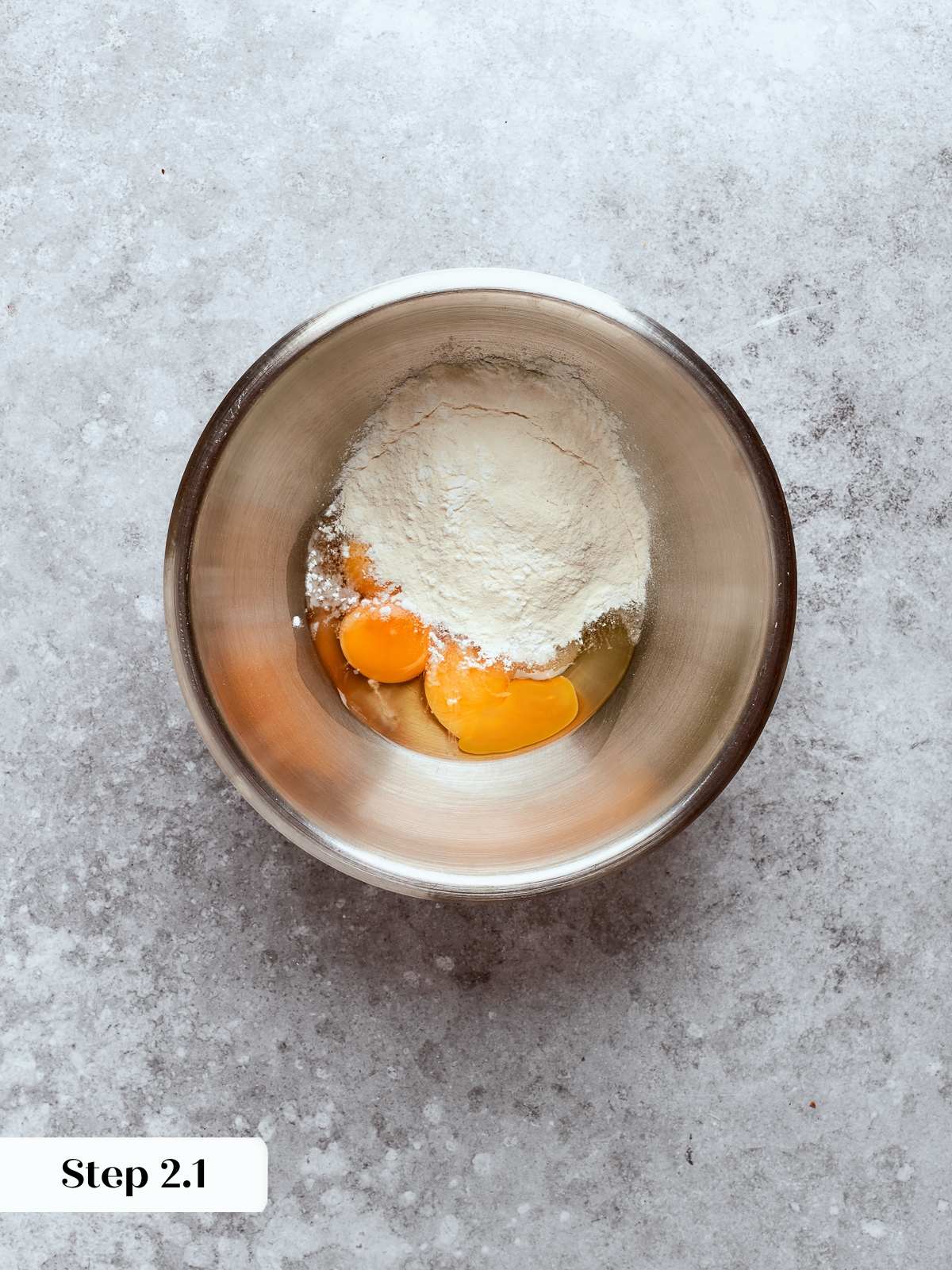
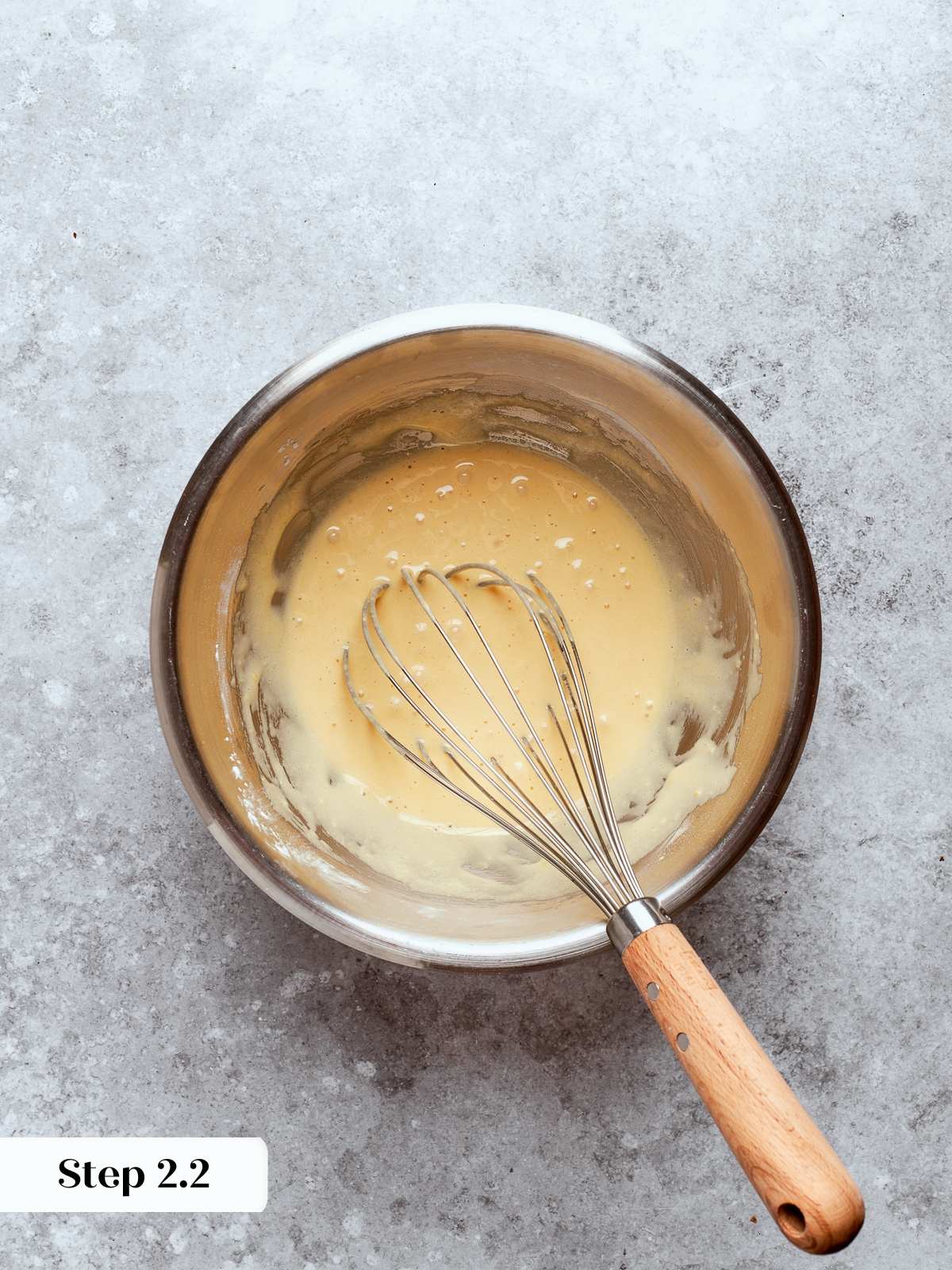
Step 2: Prepare the egg mixture and your workstation. Set a large bowl on a damp paper towel to keep it from sliding, then whisk together the whole egg, egg yolks, cornstarch, and remaining sugar until the mixture lightens to a pale, even yellow (photo 2 & 3). While the milk comes to a boil, line a baking sheet with plastic wrap or parchment paper. You will use this to spread and cool the finished pastry cream quickly.
Step 3: Temper the eggs. When the milk reaches a full rolling boil, give the egg mixture one final whisk. Pour a small amount of the hot milk into the egg mixture, whisking constantly. Gradually add more hot milk, whisking the whole time, until you have added about half. Then pour in the remaining milk and whisk vigorously to combine. Moving slowly at first is what keeps the eggs from scrambling: you are raising their temperature gradually before they hit the full heat. (photo 3).
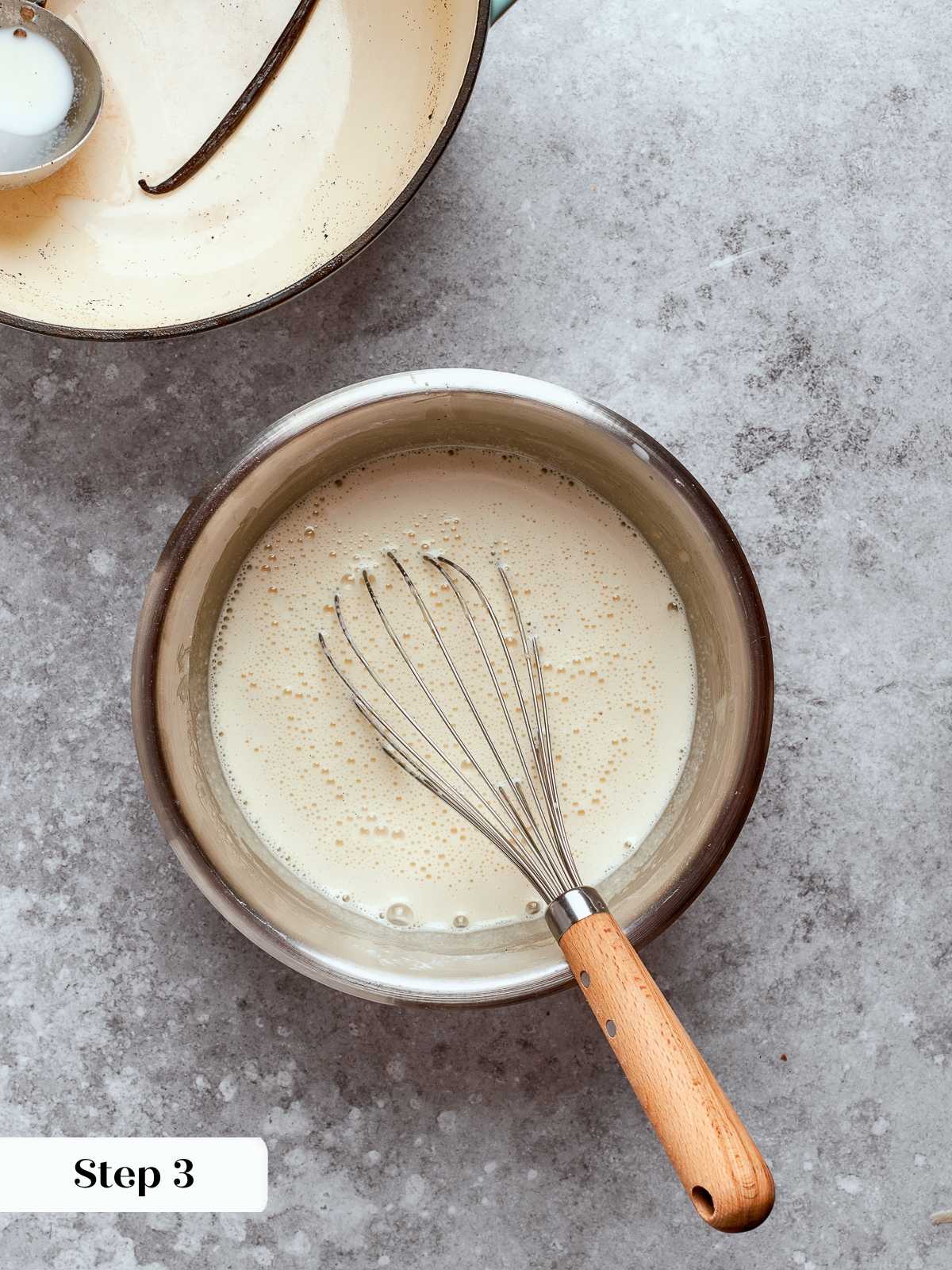
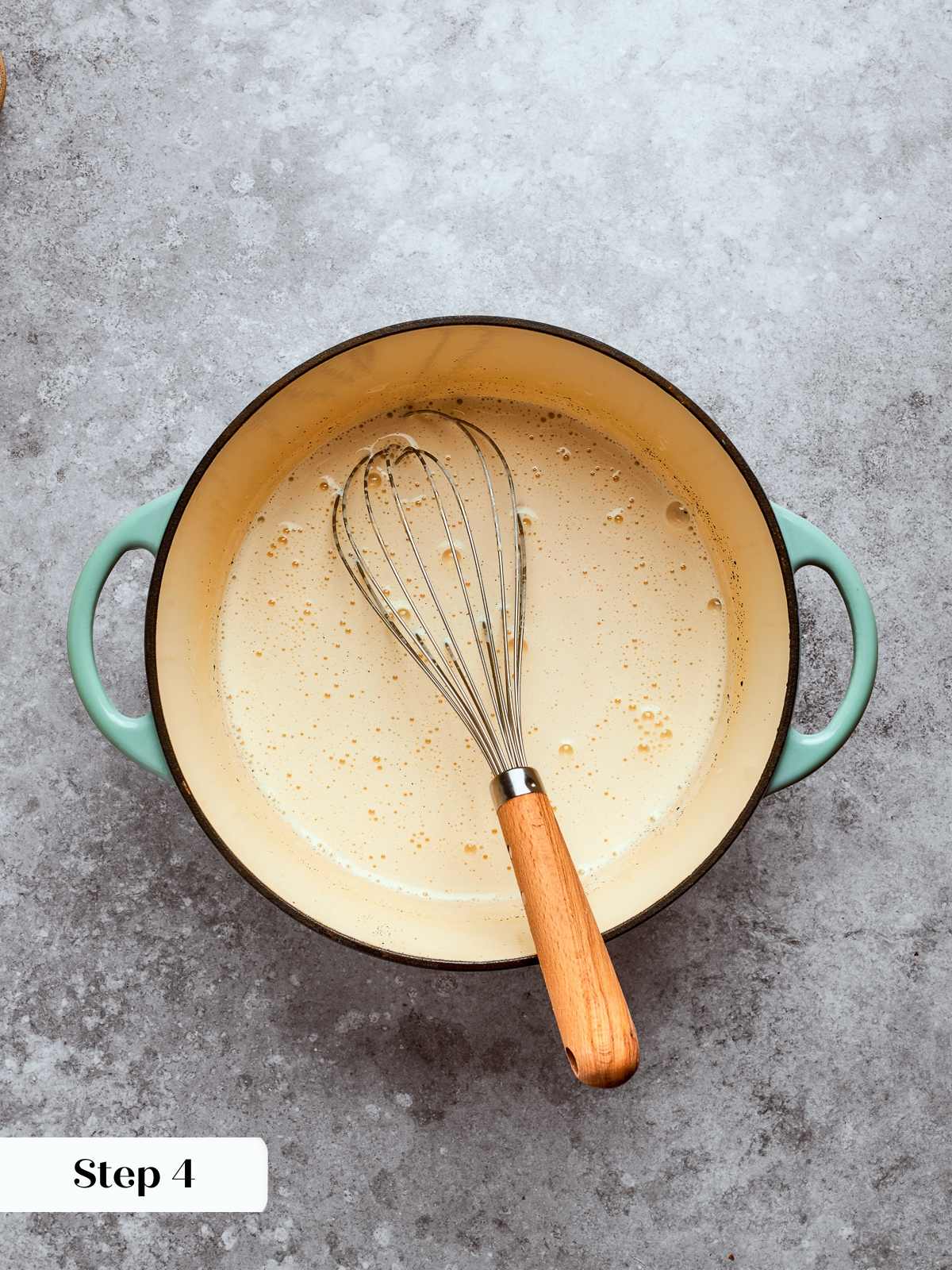
Step 4: Cook the custard base to a boil. Pour the custard base back into the same saucepot and return it to medium-high heat (photo 5). Stir constantly with a silicone spatula, paying close attention to the bottom and edges of the pot. The mixture will look thin and loose for several minutes, then you will feel it start to drag against the spatula as it thickens. The moment it begins to thicken, switch to a whisk.
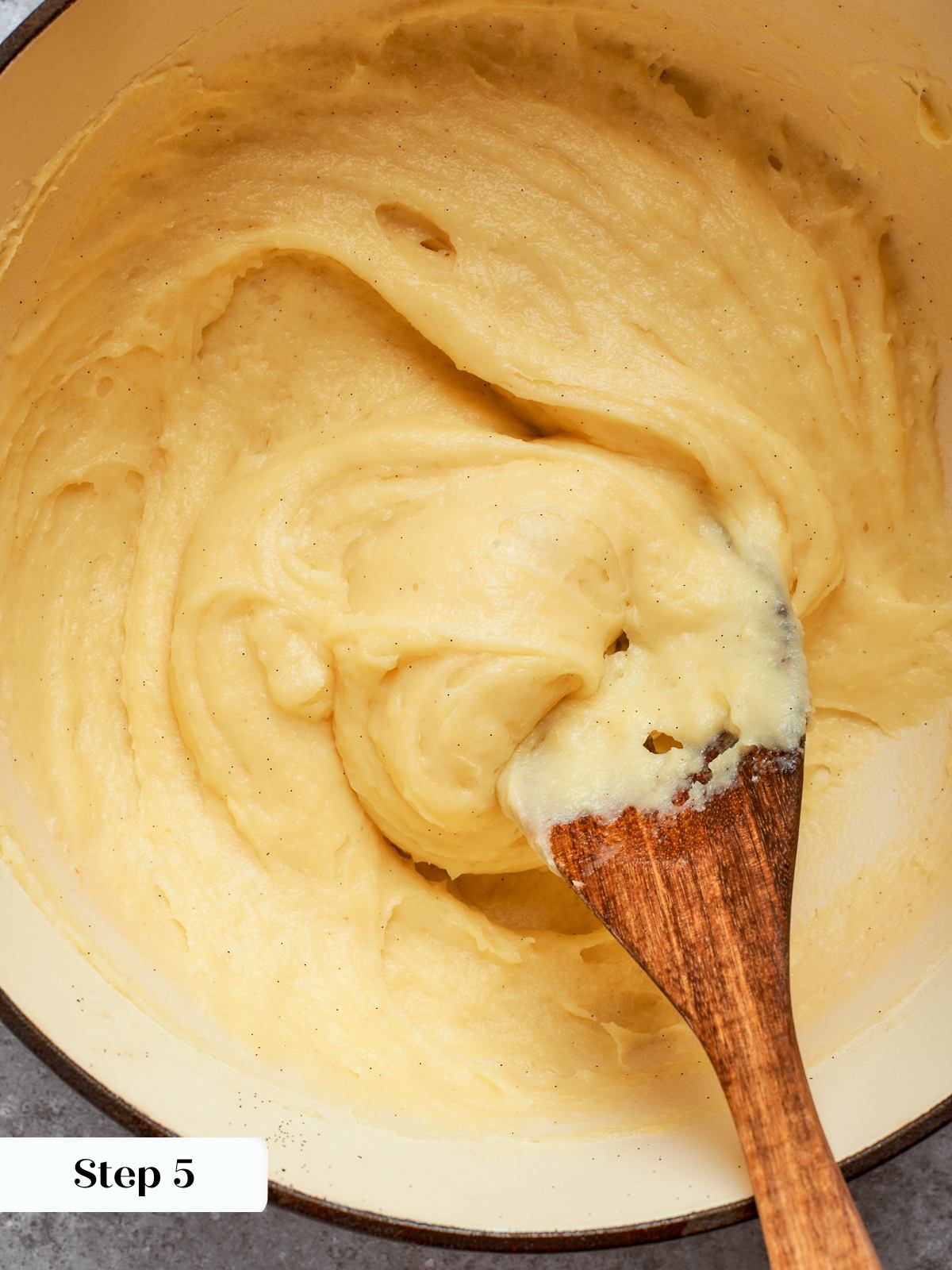
Step 5: Boil the pastry cream for one full minute. Whisk vigorously, making sure to get into the corners of the pot, and bring the pastry cream to a boil. Keep it at a boil for one full minute. This step is not optional: boiling activates the cornstarch fully and eliminates the starchy flavor that undercooked pastry cream always has. The finished cream will be thick, glossy, and hold its shape on the whisk (photo 6).
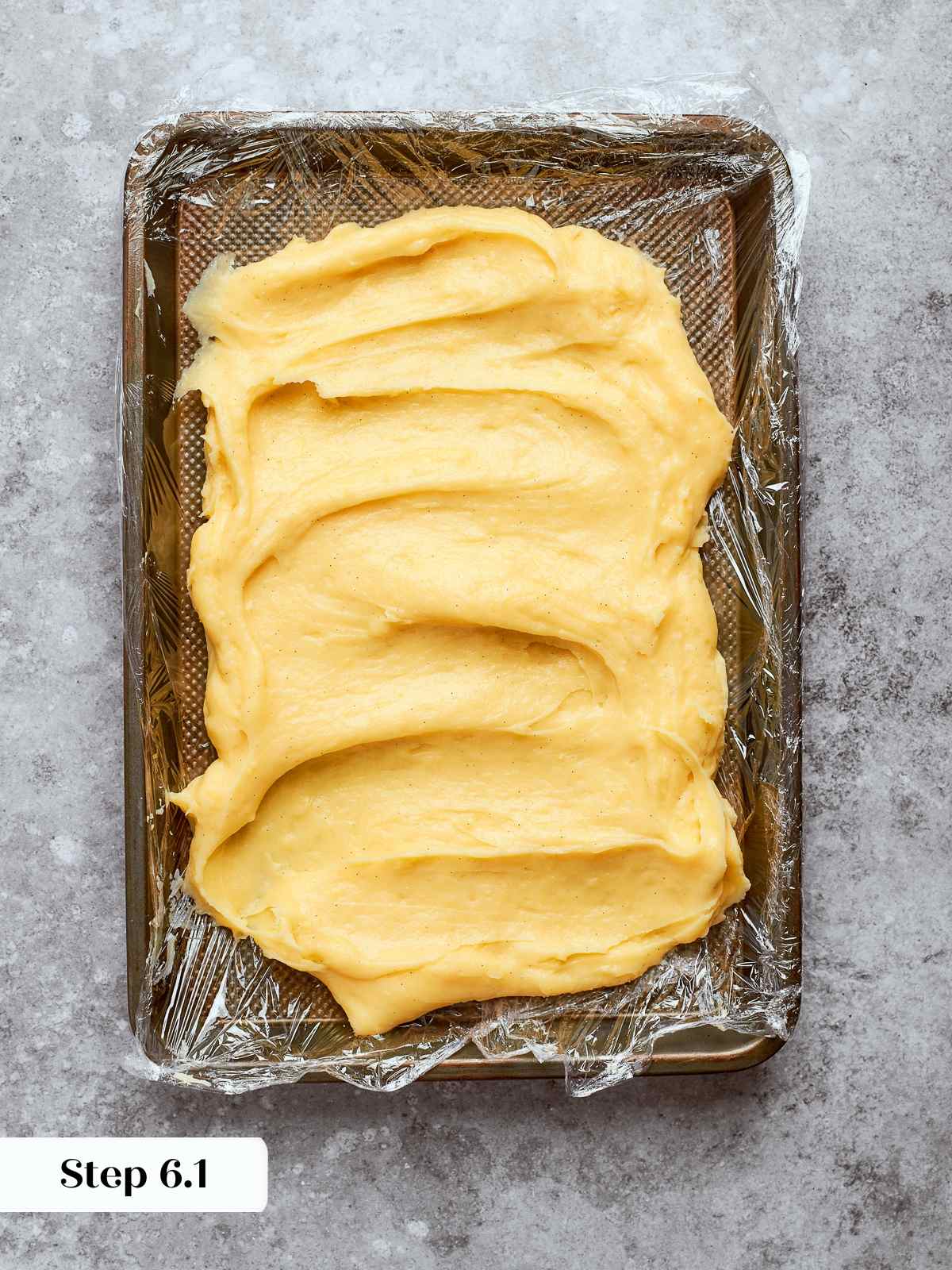
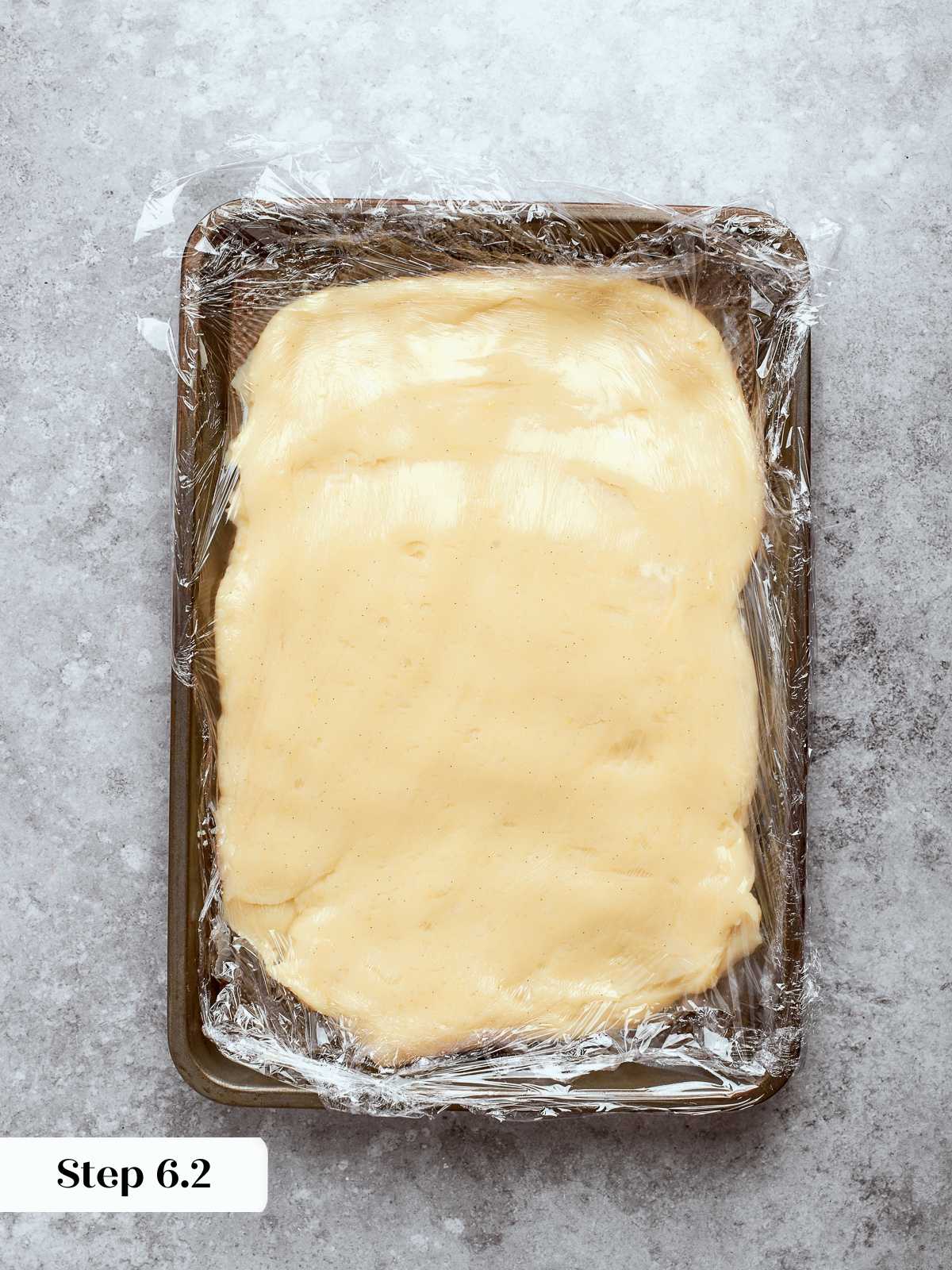
Step 6: Cool the pastry cream. Scrape the hot pastry cream onto your prepared baking sheet and spread it into an even layer (photo 7). Press a piece of plastic wrap directly onto the surface and poke a few holes to let steam escape. Refrigerate until completely cold, at least 1 hour and up to overnight. (photo 8)
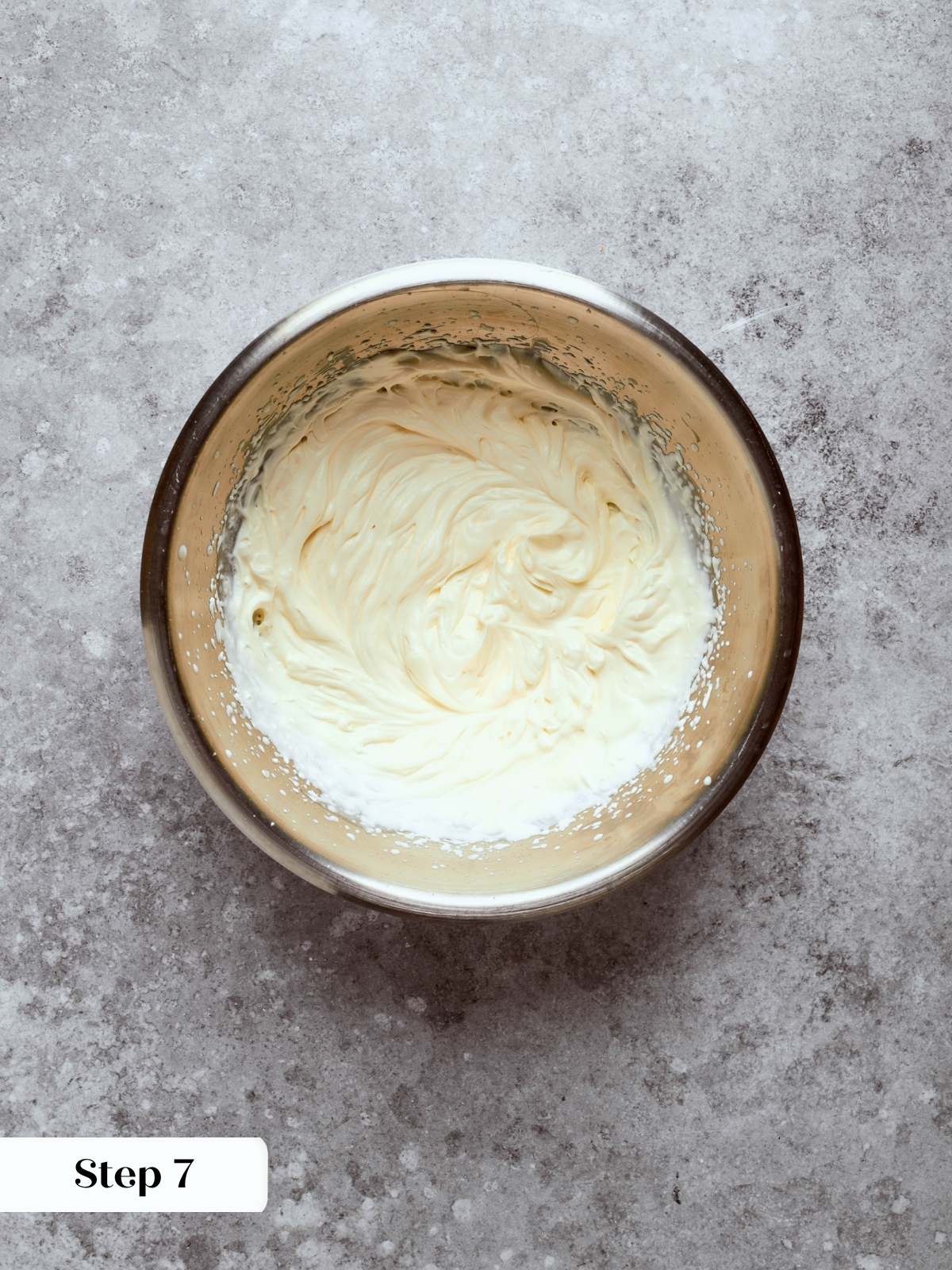
Step 7: Whip the cream to soft peaks. In the bowl of a stand mixer fitted with the whisk attachment, combine the heavy cream, powdered sugar, and vanilla extract. Whip on high speed until soft peaks form: peaks that stand up and then flop over immediately. You want them just barely holding structure, not stiff. Transfer the whipped cream to a clean bowl and set aside. (photo 9).
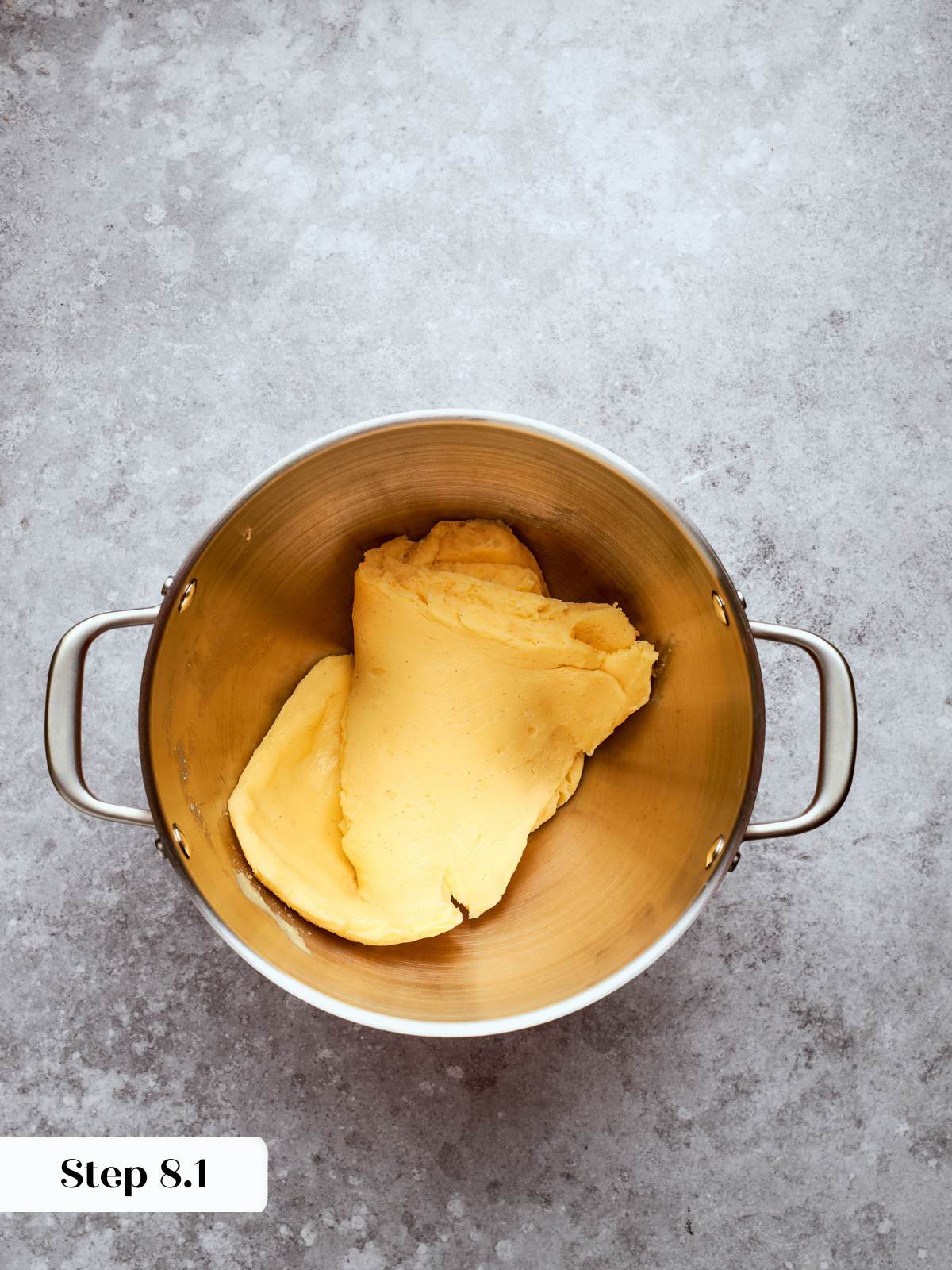
Step 8: Smooth the pastry cream. Remove the vanilla bean pod from the chilled pastry cream. Add the pastry cream to the stand mixer bowl and fit the mixer with the paddle attachment, a scraper paddle if you have one. Beat on medium-high speed until the pastry cream becomes completely smooth and looks like a thick, flowing batter. Cold pastry cream can be stiff and lumpy straight from the refrigerator, and this step is what brings it back to a workable consistency. (photo 10 & 11).
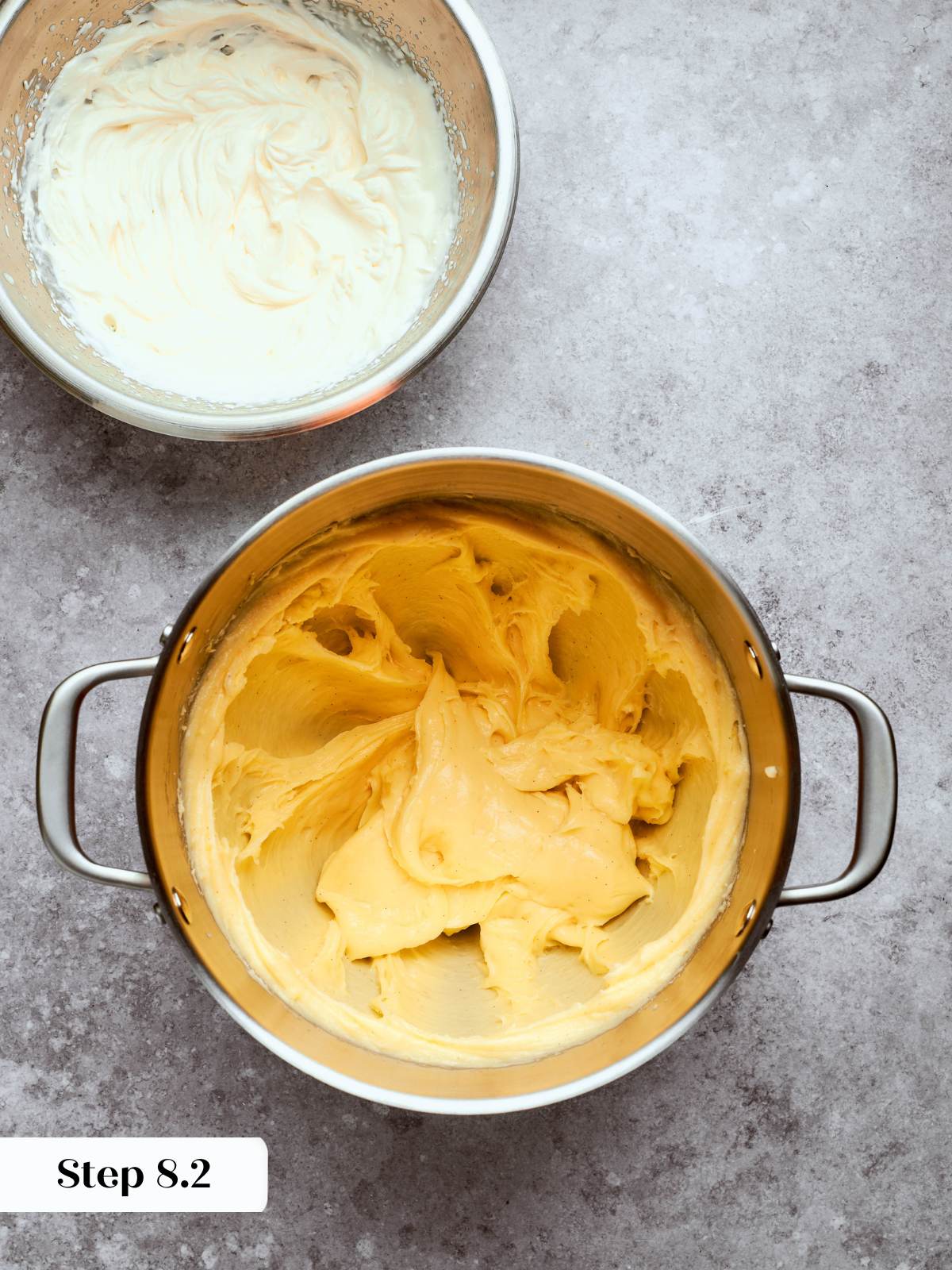
Step 9: Sacrifice a third of the whipped cream. Fold about one third of the whipped cream into the pastry cream aggressively, using a spatula with full strokes. This is called “sacrificing”: you are intentionally deflating some of the whipped cream to loosen the pastry cream base. (photo 12).
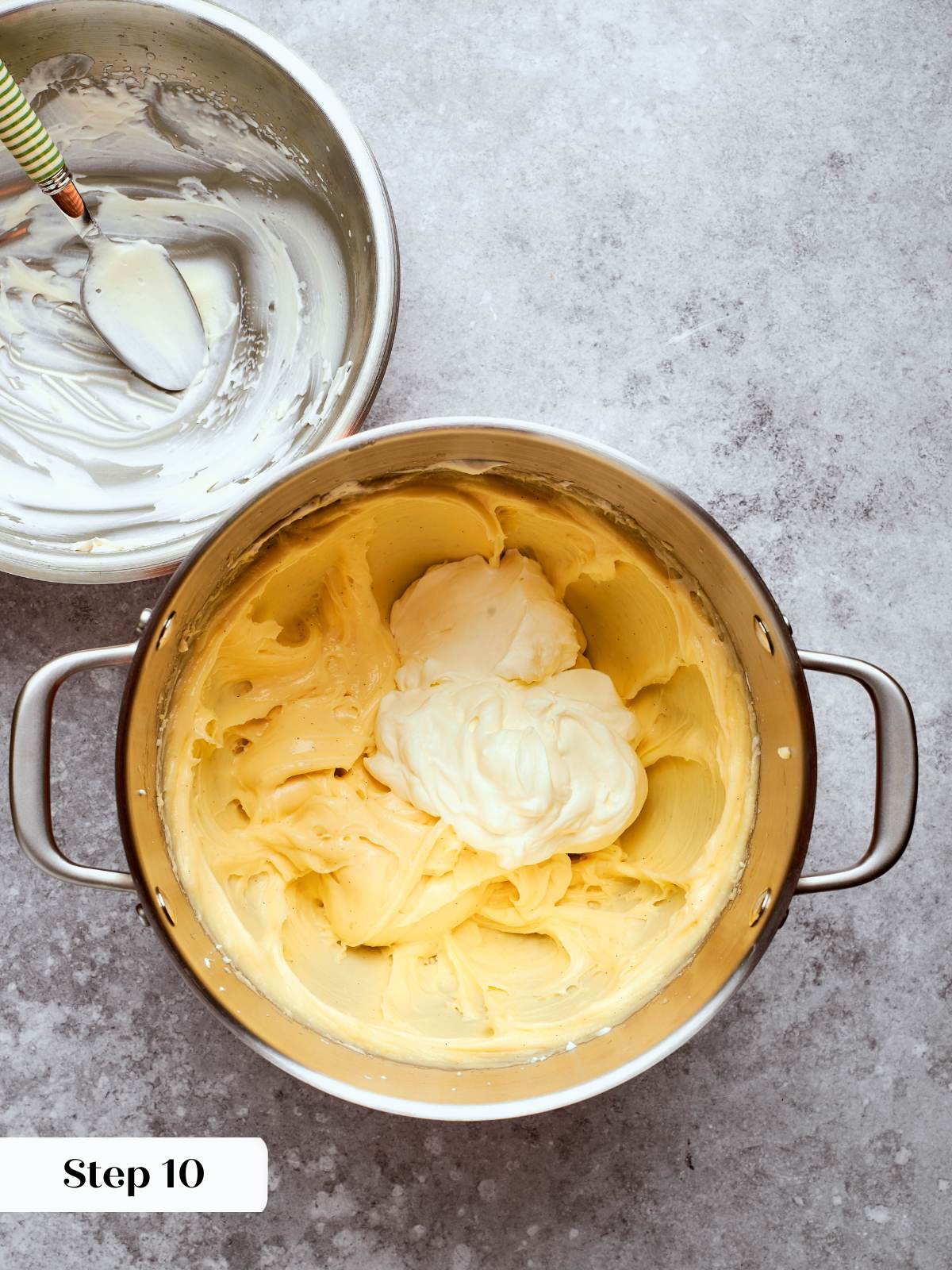
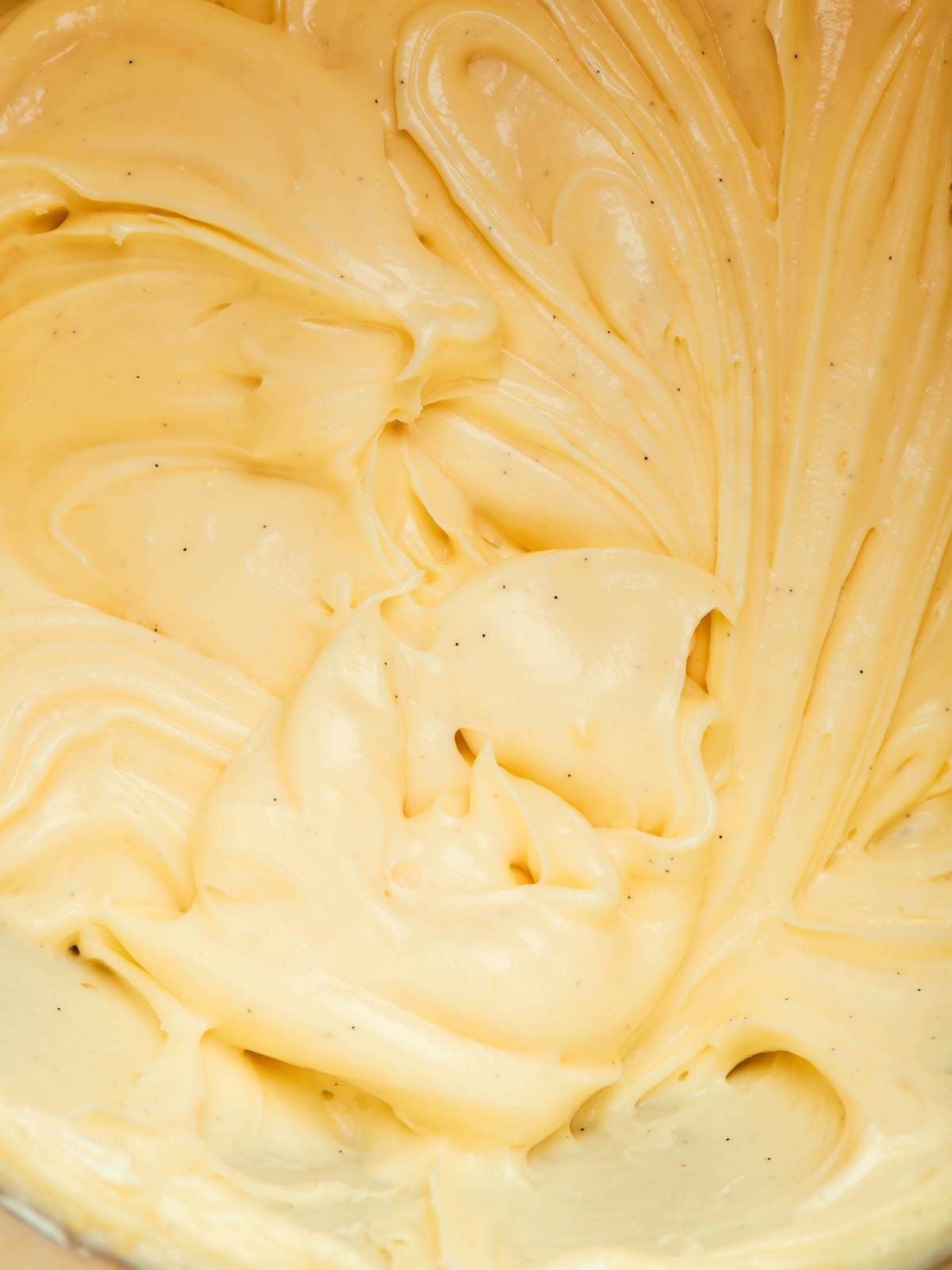
Step 10: Fold in the remaining whipped cream. Add the rest of the whipped cream to the loosened pastry cream base and fold gently to combine, using wide, sweeping strokes from the bottom of the bowl up and over the top. Stop the moment the mixture looks smooth and uniform. The finished crème légère should be light, airy, and just thick enough to hold its shape when spooned or piped. Transfer to a piping bag or leave in the bowl, and refrigerate until ready to use. (photo 13 & 14).
Chef Lindsey’s Recipe Tip
The most important thing to understand about crème légère is that it is a two-component recipe, and both components need to be in exactly the right condition before they meet. Pastry cream that is even slightly warm will melt the fat in the whipped cream on contact, and you will lose the airy texture before the fold even begins. Beyond temperature, the folding motion itself matters: use a wide spatula, work from the bottom of the bowl up and over, and stop the moment the two are combined. A few faint streaks are better than an overworked, dense filling.
Recipe FAQs
Crème légère is pastry cream lightened by folding in freshly whipped cream. Pastry cream on its own is dense and rich, while crème légère has a softer, airier texture that makes it better suited for applications where you want the filling to feel light rather than heavy. The ratio of whipped cream to pastry cream controls how mousse-like or structured the final result is.
Yes. Place the finished crème légère in the refrigerator to cool completely, at least 1 hour and up to overnight. Keep it covered so it does not absorb other flavors, and give it a gentle stir before using if it has been sitting for several hours.
Crème légère keeps for up to 3 days in the refrigerator in an airtight container. Because it contains dairy and eggs, it should not sit at room temperature for extended periods. Assembled pastries filled with crème légère are best served the same day for optimal texture.
The warmth melts the fat structure in the whipped cream almost immediately, and the mixture deflates before you can finish folding. The result is a dense, flat filling rather than the light, silky texture crème légère should have. Chilling the pastry cream completely before folding is not optional.
Lumps usually mean the egg proteins denatured when combining with sugar, the eggs weren’t tempered slowly enough and the proteins began to cook or you didn’t switch to the whisk after it thickened.
A runny result typically means the pastry cream was not cooked to a full boil and the cornstarch never reached full thickening power. Both issues are avoidable: whisk constantly, pour the hot milk in a thin stream, and keep the heat steady until you see the mixture thicken and bubble.
It is the classic filling for mille-feuille and works equally well in cream puffs, éclairs, and fresh fruit tarts. It also layers beautifully in a trifle as a more substantive alternative to whipped cream alone. You could also serve it with a slice of flourless chocolate cake or as a lighter take on vanilla bean ice cream. Essentially, anywhere you would use pastry cream but want a softer, more aerated result, crème légère is the right choice.

More French Classics
Dessert Recipes
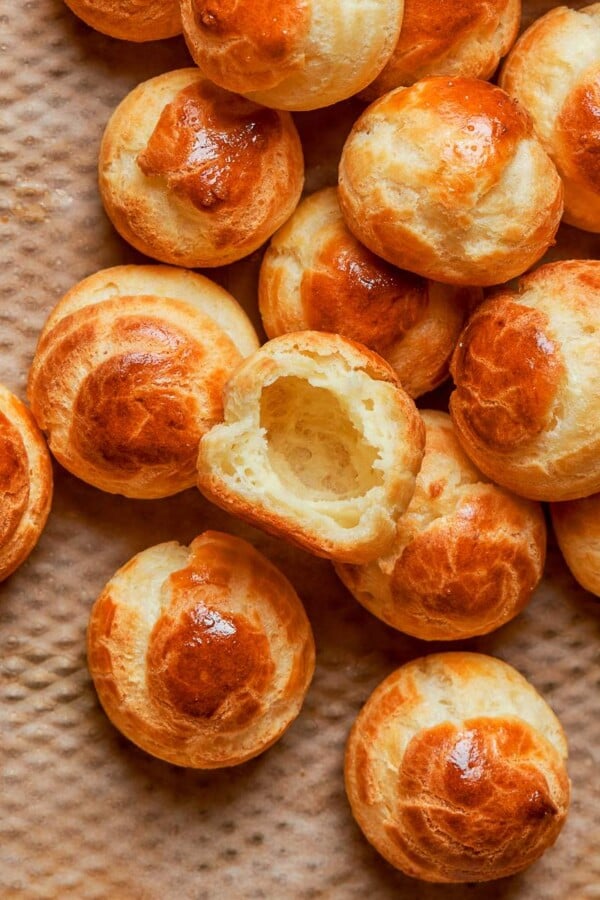
Choux Pastry (Pâte à choux)
Pies and Tart Recipes
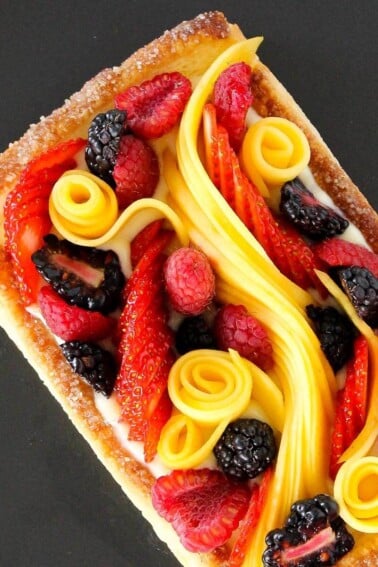
Puff Pastry Fruit Tart
Date Night
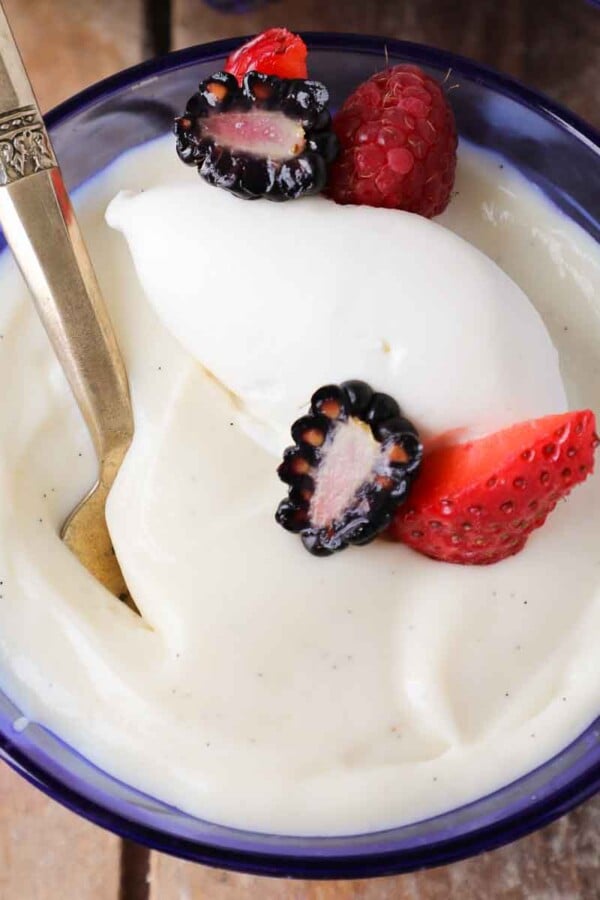
Homemade Vanilla Pudding Recipe
Dessert Recipes
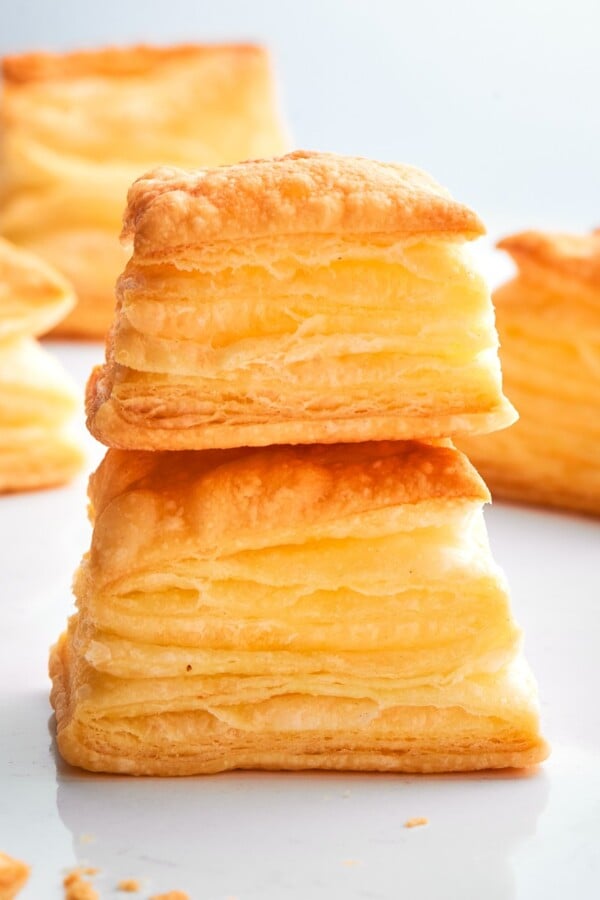
Puff Pastry Recipe
If you tried this recipe and loved it please leave a 🌟 star rating and let me know how it goes in the comments below. I love hearing from you; your comments make my day!
Crème Légère
Ingredients
- 2 cups whole milk
- ½ vanilla bean split and seeded
- ½ cup granulated sugar divided
- 1 large egg
- 2 egg yolks
- ¼ cup cornstarch
- 1 cup heavy whipping cream
- 2 tablespoons powdered sugar
- ½ teaspoon vanilla extract more to taste if desired
Instructions
- Combine the milk, vanilla bean pod and seeds, and half the sugar in a large high-sided saucepot. Stir to combine and bring to a rolling boil over medium-high heat, stirring occasionally until the sugar dissolves.
- Set a large bowl on a damp towel to stabilize it. Whisk together the whole egg, egg yolks, cornstarch, and remaining sugar until pale yellow. Line a baking sheet with plastic wrap or parchment paper.
- When the milk reaches a full rolling boil, whisk the egg mixture once more, then slowly pour in a small amount of the hot milk, whisking constantly. Gradually add more milk until you have added about half, then pour in the rest and whisk vigorously to combine.
- Return the custard base to the saucepot over medium-high heat. Stir constantly with a silicone spatula until it begins to thicken, then switch to a whisk.
- Whisk vigorously, including the corners of the pot, until the cream thickens and comes to a boil. Boil for 1 minute.
- Scrape the hot pastry cream onto the prepared baking sheet and spread it out. Cover the surface directly with plastic wrap and poke a few holes. Refrigerate until completely cool, at least 1 hour to overnight.
- In the bowl of a stand mixer fitted with the whisk attachment, combine the heavy cream, powdered sugar, and vanilla extract. Whip on high speed until soft peaks form. Transfer to a clean bowl.
- Add the cold pastry cream to the stand mixer bowl, removing the vanilla bean pod. Fit with the paddle attachment and beat on medium-high speed until smooth and the texture resembles a thick batter.
- Fold about one-third of the whipped cream into the pastry cream aggressively to loosen it. Add the remaining whipped cream and fold gently until smooth and combined.
- Transfer to a piping bag or bowl. Refrigerate until ready to use.
Notes
Chilling: The pastry cream must be completely cold before folding in the whipped cream. Even slightly warm pastry cream will deflate the whipped cream on contact.
Variations: Change the flavor by infusing the milk with matcha, folding chopped chocolate into the hot pastry cream before cooling, or using a caramel pastry cream base.
Nutrition
Before You Go
Crème légère is one of those components that quietly improves everything it touches, from filled pastries to layered cakes. If you want to keep exploring, browse my Dessert Recipes or Custard Recipes for more.








I used this crème légère to fill a fresh strawberry tart and it held its shape beautifully for hours. The tip about chilling the pastry cream completely before folding in the whipped cream made such a difference — no deflating at all. The vanilla flavor comes through so clearly. This is my new go-to filling.